Unlocked Mind Newsletter / Unlocked Mind Media
3 dimensional visualization skills are important to develop the imagination, so a good way to develop this ability is to build and work with three dimensional things. Here we share the various projects our staff have done.
It is our hope that you will see the logic (or the lack of logic) used to make the Christmas Light Flashing Machine as an example of the kind of thought and analysis that goes into our script review services.
Notice: The content presented here is for entertainment purposes only. Readers who decide to construct or modify the items mentioned here do so at their own risk and peril.
Chances are, you purchased a light flasher to use with your holiday ... let's make that Christmas decorations, and you are unhappy with the results. The cheap flasher simply does not flash on and off fast enough for you. You want your lights to flash on and off fast, like a store sign.
The problem with ordinary flashers is that they use a piece bi-metal material that when it heats up from electric current, bends, and breaks the electric circuit, turning off the lights. When the material cools, the circuit is closed, and the lights stay on until the heat from the electric current again opens the circuit. The problem is, this process can take a long time to open and close, or make the lights flash on and off.
Before we go any further, our legal department told us to include the following reminder:
WARNING: This material is for entertainment purposes only. Do not attempt to build or construct the device mentioned herein. High voltage can cause death or serious personal injury to you or others, or damage to to your property.
The better solution is a mechanical switch to turn the lights on and off faster than the bi-metallic strip heating and cooling, making the flashing more stable and reliable. For this simple project, you will need the following:
1. one magnetic reed switch. The higher the wattage rating the better, but it must be rated for at least 120 VAC, or 120 volts Alternating Current, AKA house current.
2. A small bar magnet, or a several of those powerful rare earth magnets. Each magnet should be strong enough to activate the reed switch.
3. Several feet of wire rated for 120 VAC, to connect everything together.
4. 120 VAC extension cord repair outlet. This has an electric outlet on it instead of a regular plug on the end. You can also use the outlet end of an old extension cord as well, and the extra cord with the AC plug for #7.
5. Small, low RPM motor that runs on 120 VAC. One of the motors used for turning a mirrored disco ball would work well for this purpose.
6. Small circle of 1/4" plywood, or Masonite, mounted to the shaft of the motor. Better yet is a circle of metal, so the magnets can be arranged on circle, allowing patterns to be formed to make the reed switch turn on and off in desired patterns of your own choosing.
7. AC cord, preferably recycled from some old appliance you threw out.
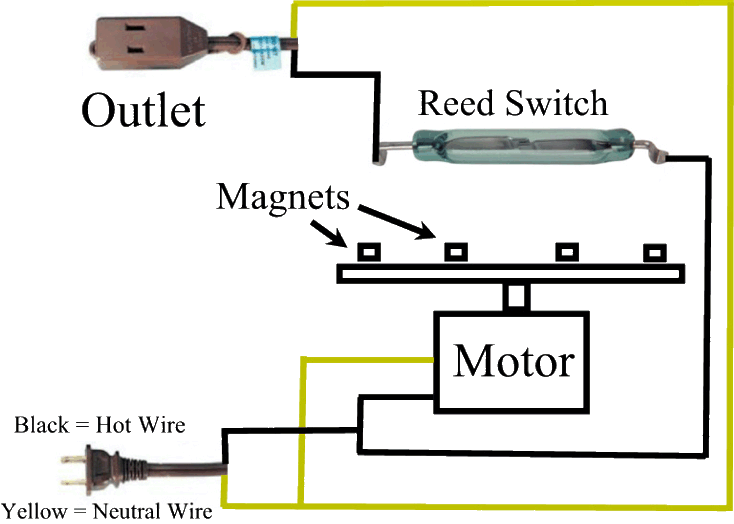
When you are finished, here is what it should look like. Notice the parts are not shown to scale, and are for illustration purposes only.
The wiring is very important. The reed switch must be wired on the hot wire. Yellow is shown instead of white. Your home/building should never have a 'hot on neutral' situation. If you are not sure why, stop right here, pick up the phone and call an experienced electrician to have the problem fixed. Now.
When the unit is plugged in, the motor starts turning, and the reed switch opens and closes, providing power to the outlet only when the reed switch is closed. Once the power is stopped, for example, when the unit is being powered by a timer, the lights won't stay on.
Store signs usually use a turning drum and mechanical switches with higher current and amperage ratings to turn the larger number of light bulbs on and off, but for most home purposes, the reed switch and magnets described here provide more control of the flashing patterns than a mechanical switch and turning drum could provide. More experienced readers would know that with the addition of some relays, this reed switch system could be used to control larger store signs as well, and could be used to replace old or worn out sign switching systems for movie theater signs.
Fun variations:
For more flashing action, you can add more reed switches (and outlets) around the circle, and more magnets. As the magnets move past the different reed switches, different flashing patterns can be obtained from the added outlets, so your Christmas decoration don't all flash on and off at the same time, making them look much more professional.
Use a larger circle, and place the magnets and reed switches along the radius of the circle for more flashing action. Magnets closer to the motor shaft with spin faster than the magnets on the outside of the circle, just as planets closer to the sun have faster orbits than planets further away from the sun.
Remember not to exceed the wattage rating of the reed switch. Higher current will make the switch arc, and may even weld the switch closed.